
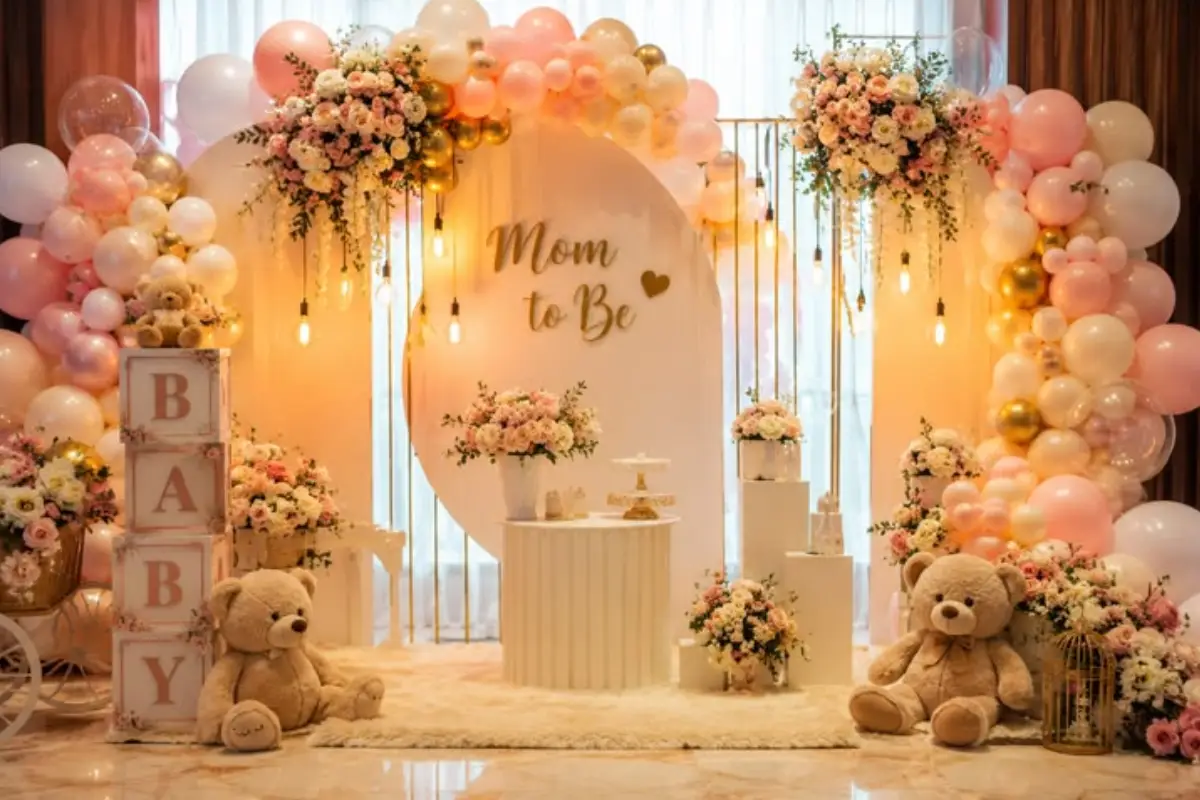
Sadh is the Bengali ceremony held for an expectant mother, usually in the seventh or ninth month of pregnancy. It is the Bengali equivalent of the godh bharai, and in English most families now simply call it the baby shower.
What happens
The mother-to-be is dressed in a new saree, traditionally given by her in-laws, and fed a large meal of her favourite foods — the heart of the ceremony is the feeding, not the gifts. Payesh is almost always part of it. Married women of the family bless her, and there is usually sindoor and a small puja depending on the household.
The ritual is traditionally hosted by the husband’s family, though plenty of families now do it jointly or at the mother’s parents’ home instead.
Sadh, godh bharai and a western baby shower
They overlap and increasingly blur. Godh bharai is the broader North Indian version; sadh is the Bengali form with its emphasis on the meal; the western baby shower brings games, a cake and a gift table. Most Kolkata celebrations we decorate are now a mix of all three, and there is nothing wrong with that — but it is worth deciding which one you are having before you plan the room, because they need different setups.
What the decoration needs to do
A traditional sadh centres on the seat and the meal, so the decoration goes around where the mother will sit and where the food is laid out. A shower-style event centres on a backdrop, a cake table and a photo corner. If you are doing both, tell your decorator both, because a backdrop built for photographs in the wrong corner of the room is money spent for nothing.
The photo corner
A baby-bump photo corner has become a standard addition — a half-arch or garland against a clean wall, nothing elaborate. It is inexpensive when added to a setup that is already being built and it is where most of the photographs end up being taken.
What we set up for sadh, baby showers and welcome-home days: baby shower and welcome baby decoration in Kolkata.
